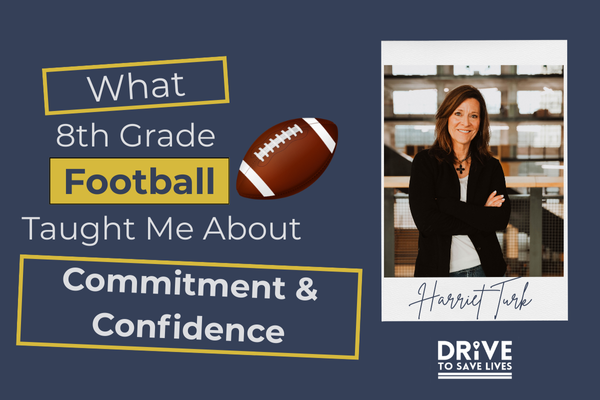
This featured blog for the month of August was written by one of the Drive to Save Lives prevention speakers, Harriet Turk.
A few years ago, I wrote this after watching my son play on the middle school football team. As a new school year begins, it reminds me of how much this experience taught both of us, and how its lessons still apply to adults and teens navigating fresh starts, new activities, and the challenges that come with them.
When your son decides to play football for the first time in 8th grade, you brace yourself for a few bumps and bruises—physical and emotional. What I didn’t expect was how much I would learn in the process, not just about him, but about myself.
From the start, Andrew’s friends wasted no time filling his head with horror stories. They told him how awful practices would be and how he was basically signing up for misery. For the first week or so, they weren’t exactly wrong. The practices were intense, the fun factor was nonexistent, and he came home every day exhausted, sore, and wanting to quit.
I’ll be honest—part of me didn’t want to fight him on it. Between the $850 in fees, the gear, and the time commitment, quitting didn’t sound like the worst idea. But I knew this was bigger than football. It was about grit. It was about seeing something through, even when your muscles hurt and your confidence is shaken.
Then came his position assignment: nose guard. A few of his friends dismissed it as a “nothing” role. I didn’t know what the position meant, but I tried to reassure him that being on the field mattered more than where he stood on it. Later, I asked our neighbor Jared, the star quarterback of the high school team, about the position. He quickly let me know that every position was important, and he was more than willing to share that wisdom with Andrew and the other players.
Game after game, I heard my son’s name over the loudspeaker: “Turk on the tackle!” The crowd started to notice, too. And then, during a play that made my heart stop and soar at the same time, Andrew came out of nowhere and sacked the quarterback. The stands went wild! I finally understood—nose guard is a powerhouse position, just as much as every other position.
When he earned the coveted tie-dyed shirt that signified “VIP Player of the Week,” all his early doubts vanished. Every moment Andrew had wanted to quit was replaced with pride, and every moment I had pushed him to stay committed felt worth it. His self-confidence skyrocketed in a matter of weeks. He didn’t just grow as a player—he grew as a person. That year of football created a foundation for showing up and sticking it out, even when things weren’t always enjoyable.
The Bigger Picture
As a new school year begins, I’m more convinced than ever that being part of something bigger than yourself matters—whether it’s football, theater, student council, marching band, or volunteering in the community. Every role a student takes on outside the classroom helps shape how they see themselves and how they engage with the world. These experiences teach patience, responsibility, resilience, and that every role, regardless of how others perceive it, has value and purpose.
As parents, educators, and mentors, our role isn’t just to applaud the wins. It’s to champion the commitment to showing up—not just when it’s easy, but especially when it’s not. It’s to help students see past the voices that say “you can’t” or “it doesn’t matter” and to find their own strength and purpose. These are the moments that build resilience, character, and confidence that last far beyond the final whistle.
Here’s to a fabulous year of intentional involvement, courageous commitment, and pride in every role you choose to tackle!
Harriet